

Every parent looks forward to their baby’s milestones, a first smile, first words, or first steps. These moments show that your baby is growing and learning in their own way.
If your baby seems slower to reach certain milestones, it’s natural to worry. While every child develops at a different pace, noticing early signs of baby development delays, especially in areas like movement, speech, or social interaction, is important. Early awareness helps parents understand when extra support may be needed.
This guide will help you recognize developmental delays, know when to seek help, and learn simple ways to support your baby’s growth at home with love and play.
What Are Developmental Delays?
A developmental delay occurs when a child doesn’t reach milestones around the expected age range in one or more areas of growth.
- Motor skills: As your baby grows, their hands and legs start moving more freely, and they begin exploring the world around them. First comes rolling over, then sitting up, crawling, and eventually walking. Along the way, your baby also learns to grasp, shake, and pick up toys or small objects, strengthening their tiny muscles. These activities help build coordination between the brain and body. Every new movement is a little victory for your baby, and a moment of pure joy for you as a parent.
- Language and communication: Your baby’s voice is their sweetest way of connecting with you. It starts with babbling, those adorable ba-ba and ma-ma sounds, and slowly turns into first words that make your heart melt. As they grow, your little one begins to understand simple directions, like come here or give me the ball. Talking, singing, and reading to your baby every day helps them pick up new words and tones. Each giggle, sound, and word builds their confidence to express themselves and turns everyday moments into beautiful conversations.
- Cognitive skills: Your baby’s brain is busy learning something new every single day. When they play with toys, try to open or stack things, they’re actually learning problem-solving. Their curiosity drives them to touch, watch, and explore everything around them. Slowly, they begin to develop memory, recognizing familiar faces, remembering sounds, or expecting what comes next in a game. Through learning by play, your baby builds the foundation for intelligence, creativity, and confidence, all while simply having fun.
- Social-emotional skills: From the very first smile, your baby begins to connect with the world emotionally. When they make eye contact, smile back, or respond to your voice, they’re learning the art of bonding and trust. These small moments help your baby understand feelings, both their own and others’. Over time, they begin to show affection, recognize familiar faces, and seek comfort when upset. Talking gently, cuddling, and playing together strengthen their sense of security an emotional confidence, laying the groundwork for healthy relationships as they grow.
- Not all delays indicate a medical condition, sometimes babies just take a little longer. But consistent delays across multiple areas may be a signal that evaluation is needed.
Harvard Center on the Developing Child explains that early experiences and interventions can reshape brain development, especially in the first three years when the brain is most adaptable.
Why Early Identification Matters
Spotting the early signs of baby development delays gives children the strongest foundation for future growth.
- Early intervention works: Programs that provide therapy and support in the first three years significantly improve outcomes (Zero to Three).
- Brain flexibility: Neural pathways are highly adaptable in infancy, meaning skills can often be strengthened with the right support.
- Parental confidence: Knowing what’s typical and when to seek help reduces anxiety and empowers you as a caregiver.
- Better long-term results: Early support can improve school readiness, language, and social-emotional skills later on.
Early action doesn’t necessarily mean something is seriously wrong, it simply gives your child the best chance to thrive.
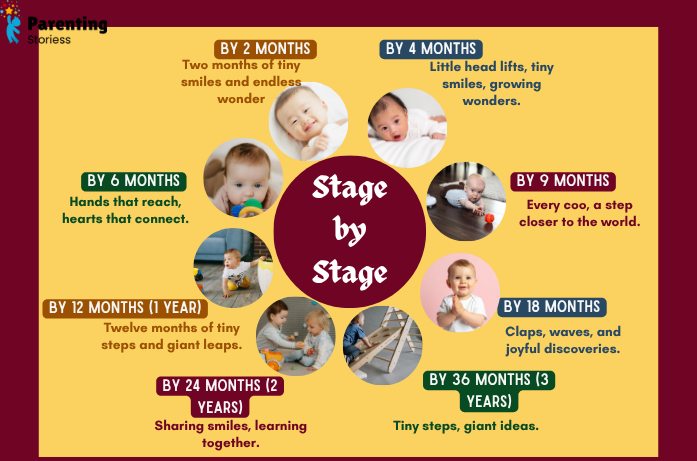
Early Signs of Baby Development Delays: Stage by Stage
Watching milestones helps parents recognize the early signs of baby development delays at different ages. Missing one milestone is usually not a concern, but repeated patterns or regression should be discussed with a pediatrician.
By 2 Months
At around two months, your little one is starting to explore the world in tiny, wonderful ways. Most babies at this age begin to smile, make sweet cooing sounds, and start noticing their surroundings and faces. You may even catch them looking at you with curiosity, beginning to form that first special bond.
Concerning Signs:
- Doesn’t respond to loud sounds.
- Doesn’t follow moving objects or watch faces.
- Doesn’t smile at people.
- Has trouble moving arms and legs smoothly.
By 4 Months
By this age, your baby is starting to hold their head more steadily and show small social responses. You might notice them lifting their head briefly during tummy time, looking at your face, or responding with coos and little smiles when you talk, laugh, or sing to them. Their tiny arms and legs are also starting to move more smoothly, and they may begin to push down with their feet, which helps strengthen their muscles.
Concerning Signs:
- Doesn’t make cooing sounds.
- Doesn’t push down with feet when placed on a surface.
- Has trouble holding their head steady or it wobbles.
- Doesn’t follow moving objects or people with their eyes.
- Appears unusually stiff or floppy.
By 6 Months
By six months, most babies are rolling over, showing affection, and exploring the world with their hands. Your little one is learning to grasp toys, bring them to their mouth, and feel different textures. They also start connecting with you through smiles, laughter, and small reactions, showing early social and emotional bonds.
Concerning Signs:
- Doesn’t try to reach for nearby objects.
- Shows no affection for parents or caregivers.
- Doesn’t respond to familiar voices or sounds.
- Has difficulty rolling over.
- Can’t hold their head steady without support.
By 9 Months
At this stage, most babies start sitting with support, babbling more, and recognizing familiar faces. You may notice your little one trying to reach for toys, turning toward voices, and showing excitement when they see you. Their hand-eye coordination is improving as they grasp, shake, and explore objects, and they begin to respond more to social cues, like smiling when someone talks to them or showing interest in new faces.
Concerning Signs:
- Doesn’t bear weight on legs even with help.
- Can’t sit with assistance.
- Doesn’t babble sounds like ba, da, ma.
- Doesn’t respond when called by name.
- Shows no recognition of familiar people or faces.
By 12 Months (1 Year)
The first birthday is an exciting milestone filled with many big developmental leaps. By now, most babies are crawling, trying to pull themselves to stand, and saying their first words. You may notice your little one exploring more confidently, responding to their name, and interacting with you through gestures, smiles, and simple games. Their curiosity is growing, and they are starting to understand basic concepts like object permanence, looking for toys you hide or reaching for things out of sight.
Concerning Signs:
- Doesn’t crawl or attempt to pull to stand.
- Doesn’t look for objects that are hidden (struggles with object permanence).
- Doesn’t wave, shake head, or point to indicate interest.
- Doesn’t say simple words like “mama” or “dada.”
- Doesn’t participate in interactive games like peek-a-boo.
Early Signs of Baby Development Delays by 18 Months
By this stage, toddlers are reaching exciting milestones. Most children begin walking independently and speaking several words, showing growing confidence and curiosity. They start pointing to things they like, imitating simple actions like clapping or waving, and responding to everyday routines. Your little one is learning to express needs and emotions, and their social awareness is increasing as they notice parents coming and going.
Concerning Signs:
- Can’t walk independently yet.
- Knows fewer than 10–20 words.
- Doesn’t point to show interest in objects or events.
- Doesn’t notice when parents leave or return.
- Doesn’t imitate simple actions like clapping, waving, or pat-a-cake.
By 24 Months (2 Years)
By this stage, toddlers are becoming more active and communicative. Most children start combining words into simple phrases, running confidently, and playing alongside or with other children. They are learning to follow simple instructions, express their needs and feelings, and explore the world more independently. Their curiosity is growing, and they begin to show interest in sharing, taking turns, and imitating actions of others during play.
Concerning Signs:
- Doesn’t use two-word phrases like more milk or go play.
- Has trouble walking steadily or falls frequently.
- Doesn’t follow simple directions such as bring the toy or sit here.
- Shows little interest in or doesn’t interact with other children.
- Vocabulary remains very limited compared to age expectations.
By 36 Months (3 Years)
At the preschool age, children become more independent, imaginative, and physically active. Most preschoolers enjoy pretend play, climbing stairs without help, and using longer, more complex sentences to communicate thoughts and ideas. They are learning to solve simple problems, follow multi-step instructions, and interact with peers. Social skills like sharing, taking turns, and expressing emotions also develop rapidly at this stage.
Concerning Signs:
- Falls often or struggles with stairs, indicating balance or coordination issues.
- Speech is unclear, even for family members, making communication difficult.
- Shows little or no interest in pretend or imaginative play.
- Doesn’t follow simple instructions or daily routines.
- Exhibits extreme separation anxiety or doesn’t adapt to brief separations from caregivers.
If you notice any of these warning signs, consult a pediatrician or child development specialist early. As a mom, you can support your child’s growth with daily loving interactions, talk, sing, read, encourage safe physical activity, pretend play, and simple interactive games. These small, consistent efforts help your little one build motor skills, language, social-emotional awareness, and confidence, laying a strong foundation for healthy development at every stage.
Common Causes of Developmental Delays
Not all delays have a clear cause, but some risk factors include:
- Premature birth or low birth weight.
- Genetic conditions (e.g., Down syndrome, Fragile X).
- Hearing or vision problems.
- Environmental factors (like lead exposure).
- Limited opportunities for play and stimulation.
- Medical complications during pregnancy or birth.
Sometimes no clear cause is found, so don’t blame yourself. The focus should be on solutions and support.
When to Call Your Pediatrician
Trust your instincts. If you’re concerned, don’t wait. Seek help if:
- Your baby consistently misses several milestones.
- You notice regression (losing skills they had).
- Your baby doesn’t respond to their name, sounds, or interaction.
- Muscle tone seems too stiff or floppy.
Pediatricians conduct routine developmental screenings during well-baby visits. Don’t hesitate to ask for extra evaluations if you’re worried.
What Parents Can Do at Home
Parents play a powerful role in supporting development, even before professional help is involved. Just 10–15 minutes of quality play and interaction each day can make a huge difference to your baby’s development.
- Play daily: Talk, sing, read, and play with your baby. During play, pay attention to their expressions, sounds, and gestures, encourage sensory exploration with toys and colors, and include simple games like peek-a-boo or touch-and-feel activities. These interactions help strengthen your baby’s language, motor skills, and social awareness.
- Encourage tummy time: This helps your baby build neck, shoulder, and arm strength, which is essential for rolling, sitting, crawling, and eventually walking. During tummy time, place toys within reach to motivate reaching and grasping, get down on the floor to interact, and gradually increase the duration as your baby becomes more comfortable. Regular tummy time also supports visual tracking, coordination, and early motor development.
- Foster social interaction: Games like peek-a-boo, clapping, smiling, and hand gestures strengthen the bond between you and your baby. These activities help your child read social cues, understand emotions, and feel connected to others. During play, maintain eye contact, use their name, and respond to their actions to boost confidence and trust. Regular social games also support your baby’s social awareness, language skills, and emotional development.
- Create a safe space: Babies need a secure area where they can crawl, roll, and explore freely without risk of injury. Use baby gates, soft mats, and remove sharp or small objects to prevent accidents. A safe space encourages independent movement, curiosity, and confidence, and allows your little one to practice new skills like reaching, pulling up, and standing while you supervise. Regularly rotate toys and objects to keep exploration engaging and stimulating.
- Be responsive: React to your baby’s babbles, gestures, and eye contact to encourage early communication and language development. Repeat sounds, name objects, and respond with smiles or words to show your baby that their attempts at communication are meaningful. Being attentive helps your child learn conversation patterns, express needs, and develop social-emotional bonds. Consistent responsiveness builds confidence, curiosity, and a stronger connection between you and your baby.
- Early Intervention Services
If delays are identified, early intervention can provide targeted support:
· Speech therapy: Helps your child develop communication, vocabulary, and comprehension skills, and addresses issues like articulation, stuttering, or delayed language.
· Physical therapy: Strengthens muscles, balance, and motor coordination, supporting milestones like sitting, crawling, walking, and climbing.
· Occupational therapy: Builds daily living skills, fine motor coordination, sensory processing, and self-care abilities, helping children become more independent.
· Special education services: Offers tailored learning support, individualized plans, and classroom adaptations for children with broader developmental delays, ensuring they can learn effectively and reach their potential.
In the U.S., under the Individuals with Disabilities Education Act (IDEA), eligible children under age 3 can access free early intervention services.
Myths About Developmental Delays
- They’ll grow out of it. Some do, but many need support. Waiting can delay progress.
- Boys just talk later. While differences exist, significant speech delays should not be dismissed.
- It’s my fault as a parent. Most delays aren’t caused by parenting. What matters is taking action early.
FAQs About Developmental Delays
1. How do I know if my baby’s delay is serious?
Mild variations are normal, but consistent or multiple delays should be checked by a pediatrician.
2. Can delays be treated?
Yes. Early therapy often helps children catch up or develop alternative strategies.
3. Should I wait and see?
No. The American Academy of Pediatrics advises against waiting if you’re concerned.
4. Are developmental screenings routine?
Yes. Pediatricians usually screen milestones during well-baby visits. Parents can request additional screenings at any time.
5. Are boys and girls different in developmental milestones?
Generally, no. Both follow similar timelines, though small differences may occur.
6. What if my baby reaches a milestone early or late?
Both are normal. Every child develops at their own pace.
Final Thoughts
Every child develops at their own pace. Missing a milestone isn’t always cause for alarm, but knowing the early signs of baby development delays allows you to act with confidence. If you’re concerned, talk to your pediatrician. Early support can make a lifelong difference.
At Parenting Stories, we believe that awareness of the early signs of baby development delays empowers parents to build a stronger, healthier future for their children.
Disclaimer:
This article is for informational purposes only. It does not replace professional medical advice. Always consult your pediatrician if you are concerned about your child’s development.