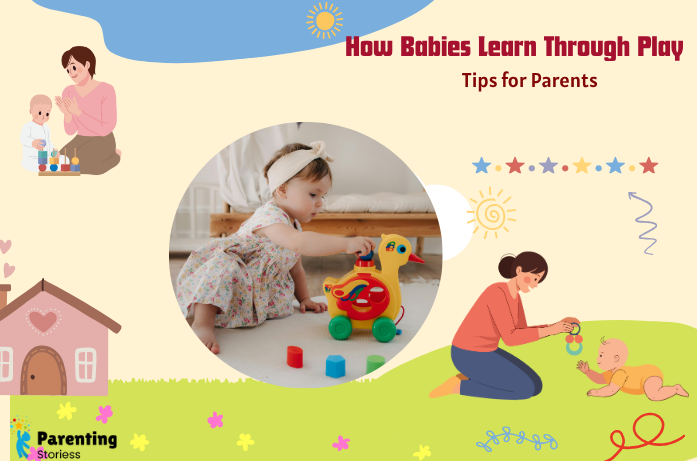
Play is more than just fun, it’s the way babies learn about the world. Every giggle during peek-a-boo, every block tower knocked over, every splash in the bath is quietly building your baby’s brain. Experts often call play the “work of childhood”, because it is through play that children practice physical movement, problem-solving, social interaction, and emotional expression.
From the very beginning, babies use play to make sense of their environment. A newborn following your face with their eyes, a six-month-old shaking a rattle, or a toddler pretending to feed a doll, these moments might look simple, but they are rich learning opportunities. According to the National Association for the Education of Young Children (NAEYC), early experiences like play strengthen brain circuits that support memory, attention, and emotional well-being for life. “Her story isn’t unique, every playful moment, from peek-a-boo to stacking blocks, is quietly building your baby’s brain.”
This guide will explore how babies learn through play, what kinds of play matter most at each stage of development, and how parents can make everyday interactions joyful, meaningful, and enriching.
Why Play Matters for Babies
Play isn’t a time-filler, it’s the engine of early learning. In those small, everyday moments (peek-a-boo, splashing, stacking), babies are wiring brain pathways for thinking, moving, and relating to others. The back-and-forth “serve and return” between baby and caregiver during play (you smile, they smile back; you roll a ball, they reach for it) builds attention, trust, and curiosity, skills that power later milestones like reading, problem-solving, and teamwork.
Think of play as a whole-body, whole-brain workout that also strengthens your bond with your baby. It doesn’t need fancy toys; your face, voice, and safe household items are often best.
- Brain development: Play lights up multiple brain areas at once. Repetition (songs, simple games) strengthens neural connections, making it easier for babies to focus, remember patterns, and learn new skills faster.
- Motor skills: Reaching for a rattle, rolling toward a toy, or crawling after a ball builds strength, balance, and coordination, the foundation for sitting, standing, and walking.
- Language: Singing, sound play (“ba-ba-ba”), and naming what baby sees turn everyday moments into mini language lessons, growing vocabulary and tuning the ear to speech sounds.
- Social–emotional growth: Play with responsive caregivers teaches turn-taking, reading facial cues, and soothing big feelings, key building blocks for empathy, cooperation, and secure attachment.
- Problem-solving: Figuring out how blocks stack, how lids open, or why a toy makes noise builds persistence, cause-and-effect understanding, and early logical thinking.
According to the Harvard Center on the Developing Child, play-based, hands-on experiences, and especially “serve-and-return” interactions, are powerful drivers of early learning and healthy development.
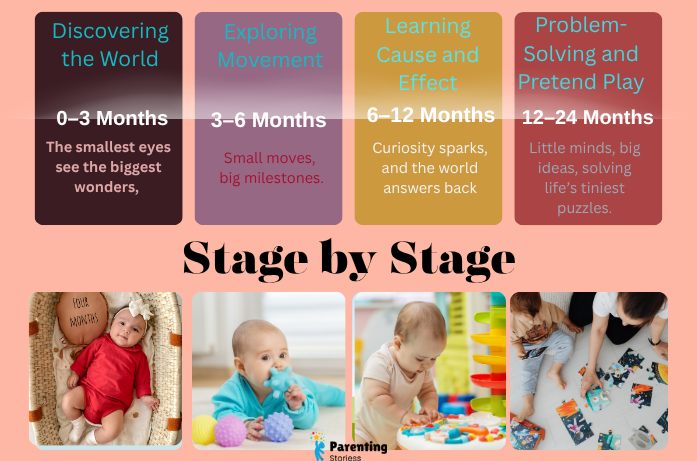
How Babies Learn Through Play: Stage by Stage
Every stage of development brings new opportunities for play. Babies learn differently at 2 months than at 2 years, but in each stage, play is their natural classroom.
0–3 Months: Discovering the World
In the first few months, babies are mostly observers, taking in the world through their senses. Play at this age is about bonding, eye contact, and responding to your baby’s curiosity.
“Here’s how you can make play meaningful in these early months:”
Ways to play at this stage:
- Smile, sing, and talk gently while maintaining eye contact.
- Use rattles or high-contrast toys to encourage babies to track with their eyes.
- Place your baby on their tummy for a few minutes each day and lie down face-to-face.
Even at this young age, your baby is already learning cause-and-effect: “When I move my arm, the rattle makes noise.”
3–6 Months: Exploring Movement
By three months, babies begin exploring their bodies. This stage is key for motor skill development through play.
Play ideas:
- Offer lightweight toys that are easy to hold and shake.
- Play peek-a-boo to build anticipation and social interaction.
- Place toys slightly out of reach during tummy time to motivate stretching and rolling.
This stage is when babies begin recognizing routines and predictability: “When dad smiles, I smile back.” These repeated patterns build trust and emotional security.
6–12 Months: Learning Cause and Effect
By six months, babies become little explorers. They drop spoons, bang toys, and open and close containers. This is their way of testing how the world works.
Activities to try:
- Play stacking and knocking-down games.
- Introduce safe household items (plastic cups, spoons, lids) for exploration.
- Clap together, play pat-a-cake, or sing songs with actions.
At this age, babies are also developing problem-solving skills: “If I push this, it falls. If I shake it, it makes noise.” These experiments are the foundation of logical thinking.
12–24 Months: Problem-Solving and Pretend Play
Toddlers begin to imitate adults, pretend, and explore independence. Pretend play is especially important for imagination and empathy.
How to encourage learning:
- Offer blocks, stacking cups, or shape sorters for problem-solving practice.
- Encourage pretend play with dolls, stuffed animals, or toy kitchens.
- Read picture books and let toddlers point to objects, turn pages, and name things.
Through this stage, toddlers learn cooperation, persistence, and early social rules, like taking turns.
2–3 Years: Creativity and Social Play
By two years, children move from playing alone to playing alongside others (parallel play) and gradually toward cooperative play. They experiment with creativity, independence, and social roles.
Great activities for this stage:
- Provide crayons, finger paints, or safe clay for creative expression.
- Play simple memory games, puzzles, or matching activities.
- Encourage outdoor play, running, digging, climbing, and chasing bubbles.
At this age, children also start role play, pretending to be a doctor, a parent, or even their favorite animal. These activities expand both imagination and problem-solving.
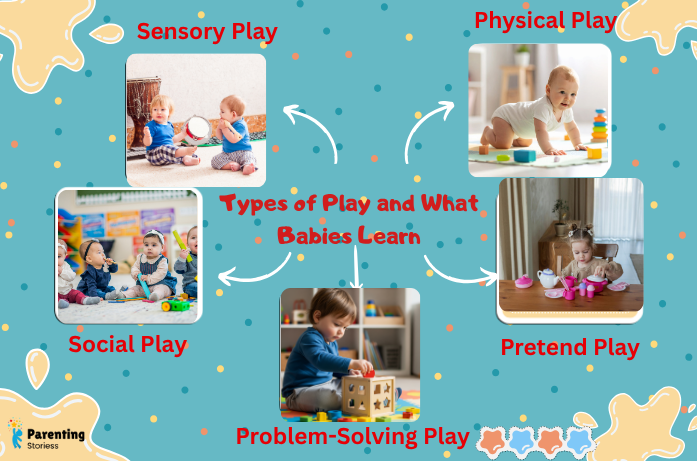
Types of Play and What Babies Learn
Not every game looks the same, and that’s a good thing. Different kinds of play work different parts of a baby’s brain and body. Think of it like a “play diet”: a little sensory, physical, social, pretend, and problem-solving play through the day. Switching it up helps babies learn better, avoids boredom, and turns everyday moments (bath time, meals, diaper changes) into learning opportunities.
1) Sensory Play
What it teaches: Noticing sights, sounds, textures, smells, and tastes; early attention and curiosity.
Try this: Let baby splash in a bowl of water, touch soft or crinkly fabric, explore (with supervision) dry lentils/rice, smell an orange peel, look at high-contrast books.
Watch for: If baby turns away or gets fussy, take a break. Keep sessions short and calm; offer one new texture at a time.
2) Physical Play
What it teaches: Core strength, balance, coordination, the base for rolling, sitting, crawling, and walking.
Try this: Tummy time, place a toy just out of reach, roll a soft ball back and forth, make a cushion “tunnel” for crawling, gentle dancing in your arms.
Watch for: A safe, open space. Increase challenge slowly (toy a bit farther, slightly uneven surface like a folded blanket).
3) Social Play
What it teaches: Bonding, trust, turn-taking, reading faces/voices, early cooperation.
Try this: Peek-a-boo, clapping games, action songs, simple back-and-forth games (you roll the ball, baby rolls back), copy baby’s sounds and expressions.
Watch for: Follow baby’s lead. If they look away, pause. Celebrate even tiny “turns.”
4) Pretend Play
What it teaches: Imagination, empathy, flexible thinking, understanding daily roles/routines.
Try this (around 12–24 months): “Feed” a doll, pretend phone calls, toy kitchen play, stuffed-animal “checkup,” act out bath/bedtime with toys.
Watch for: Let your child’s story lead; lightly narrate (“Teddy is sleepy!”) instead of directing.
5) Problem-Solving Play
What it teaches: Persistence, cause-and-effect, early logic, fine motor skills.
Try this: Stacking cups, shape sorters, big-piece puzzles, filling and dumping containers, opening and closing lids, small ramps for cars/balls.
Watch for: Give a “just-right” challenge, add a small twist if it’s too easy; if it’s hard, simplify and model one step.
How to use it: Each day, add a few minutes from 2–3 categories. Keep sessions short, follow your baby’s cues, and repeat favorite games, repetition is how the brain builds strong connections.
Tips for Parents: Encouraging Learning Through Play
Parents don’t need expensive toys, simple routines can be powerful baby learning activities.
- Follow your baby’s lead: Notice what interests them and join in.
- Keep it simple: Pots, spoons, scarves, and cardboard boxes can be more exciting than fancy toys.
- Be responsive: Smile, talk, and encourage attempts, even if they’re small.
- Create a safe space: Babies learn best when they’re free to explore without danger.
- Balance play with rest: Babies need downtime to process what they learn.
- Join the fun: Sit on the floor, clap, sing, or pretend, you’re your baby’s favorite playmate.
Mistakes Parents Often Make
Even with the best intentions, some habits can get in the way of learning through play:
- Overloading with toys or structured lessons: Babies need freedom to explore, not pressure.
- Relying on screens: Passive entertainment doesn’t build brain connections like active play does.
- Comparing babies to others: Development is unique, focus on your child’s progress.
- Thinking play is “just fun”: Play is the foundation of learning and emotional health.
FAQs About Play and Learning
1. Do babies need expensive toys to learn?
No. Your voice, cuddles, and everyday objects are more powerful than gadgets.
2. How much should I play with my baby each day?
Play happens naturally in routines, singing during bath time, chatting while folding laundry, or making faces during diaper changes all count.
3. Is screen time helpful for baby learning?
No. The American Academy of Pediatrics (AAP) advises avoiding screen time for babies under 18 months (except for video calls). Babies learn best from real interactions.
4. What if my baby doesn’t seem interested in play?
That’s fine. Keep sessions short and follow their mood. Babies learn best when alert and relaxed.
5.Are boys and girls different in play development?
Not significantly. Milestones are mostly the same, though every baby learns at their own pace.
6.Can play really replace early lessons or flashcards?
Yes. Active, hands-on play builds stronger brain connections than memorization or early drills.
Final Thoughts
Play is not extra, it’s the language of learning for babies. Through play, your child strengthens their brain, builds motor and language skills, learns problem-solving, and forms emotional bonds with you.
The best part? Baby development through play doesn’t require special tools. Every cuddle, giggle, and game contributes to growth. Encourage play daily, and watch your little one learn, grow, and thrive.
At Parenting Stories, we believe the greatest gift you can give your baby is your time, attention, and love. Encourage play every day, and watch your little one learn, grow, and thrive.
Disclaimer: This article is for informational purposes only and should not replace medical or developmental advice. Always consult your pediatrician for guidance specific to your child.