Few things bring more joy to parents than hearing their baby’s first words. That tiny “mama,” “dada,” or even a stream of playful babble feels like magic, it’s proof that your baby is learning to connect with you in a whole new way. But speech and language skills don’t appear overnight. They develop gradually, starting with coos, giggles, and babbling long before your baby can say a real word.
“Each coo and babble may sound simple, but they’re the first building blocks of language.”
The exciting part is that parents play a powerful role in this journey. Your baby learns language by hearing you speak, watching your facial expressions, and practicing sounds in back-and-forth interactions. The more you talk, sing, and engage with your little one, the more opportunities they get to build strong communication skills.
According to the American Academy of Pediatrics (AAP), a baby’s brain is most receptive to language learning in the first three years of life. That makes these early years the best time to nurture speech and lay the foundation for future learning.
This guide explains how speech development unfolds, what milestones to look for, and practical ways to encourage your baby’s language growth, all with simple, everyday strategies you can use at home.
How Speech Development Begins
Speech is more than just talking. It’s a blend of listening, understanding, and expressing. Babies move through predictable stages, but every child has their own rhythm. Here’s what most parents can expect:
- 0–3 months: Babies coo, make gurgling sounds, and cry differently depending on their needs. They calm when they hear familiar voices.
- 4–6 months: Babbling starts, “ba,” “ga,” “da.” Babies experiment with sounds and may squeal or laugh in response to you.
- 7–12 months: Babbling gets more complex (“mamama,” “dadada”), and babies may say their first simple words. They begin to recognize names and simple requests.
- 12–18 months: Vocabulary grows to 10–20 words. Babies point, wave, and follow basic instructions (“come here,” “give me”).
- 18–24 months: Word count increases rapidly, often 50+ words, and two-word combinations appear (“more milk,” “go park”).
- 2–3 years: Vocabulary explodes, sentences get longer, and toddlers begin asking endless “why” and “what” questions. Speech becomes clearer.
For a detailed breakdown of baby speech milestones, see the CDC’s Developmental Milestones.
Why Early Speech Development Matters
Early communication is more than just words, it’s the building block of connection and learning. Supporting your baby’s speech helps in many ways:
- Brain growth: The first three years are when language development in infants accelerates.
- Bonding: Talking and listening strengthen your relationship with your baby.
- Cognitive development: Speech supports memory, problem-solving, and learning.
- School readiness: Early vocabulary is a strong predictor of reading and academic success.
How Parents Can Encourage Speech Development
The best part? You don’t need special toys or programs. Everyday moments, feeding, playing, diaper changes, car rides, are perfect opportunities for activities to encourage speech.
1. Talk Throughout the Day
Babies learn by hearing words over and over. Narrate your daily routines so your baby is surrounded by language.
Example: “We’re putting on your socks, first the red one, now the blue one.”
“You don’t need special lessons, just everyday chatter makes a huge difference.”
2. Read Aloud Early and Often
Reading is one of the most powerful tools for speech development. Even newborns benefit from hearing the rhythm of language.
- Choose colorful board books for babies.
- Use different voices, expressions, and sound effects.
- Point to pictures and label them: “Dog. Woof!”
The American Speech-Language-Hearing Association (ASHA) notes that reading aloud builds both understanding and expression.
3. Sing and Play with Music
Music is full of rhythm, rhyme, and repetition, all vital for language development in infants.
- Sing lullabies, nursery rhymes, or even your favorite songs.
- Add gestures or clapping to songs like “If You’re Happy and You Know It.”
- Use simple instruments or rattles as your baby grows.
4. Encourage Babbling and Imitation
When your baby babbles, treat it like conversation. Smile, respond, and take turns. This “serve and return” style teaches communication is a two-way street.
“Think of it as having a conversation, even if it’s all babbles, your response teaches your baby that their voice matters.”
5. Use Gestures and Expressions
Gestures like waving, pointing, and clapping often come before words. Encouraging gestures supports speech and language development.
6. Label the World Around Them
Name objects your baby sees daily, cup, ball, spoon, dog. Use short, clear sentences. As they grow, ask questions like: “Where’s your ball?” This builds understanding and recall.
7. Limit Screen Time
Real-life interaction beats screens every time. The AAP recommends avoiding screen time under 18 months (except video calls). Less screen time = more language-rich environment.
8. Play Interactive Games
Games like peek-a-boo and pat-a-cake aren’t just fun, they teach turn-taking, anticipation, and social language skills.
9. Create a Language-Rich Environment
Surround your child with conversation. Talk to them during car rides, grocery trips, or bath time. Introduce new words naturally: “This apple is crunchy.”
10. Be Patient and Encouraging
Celebrate all attempts to communicate. Instead of correcting mistakes, model the correct word:
Baby says: “Wa-wa.”
Parent responds: “Yes, water. You want water.”
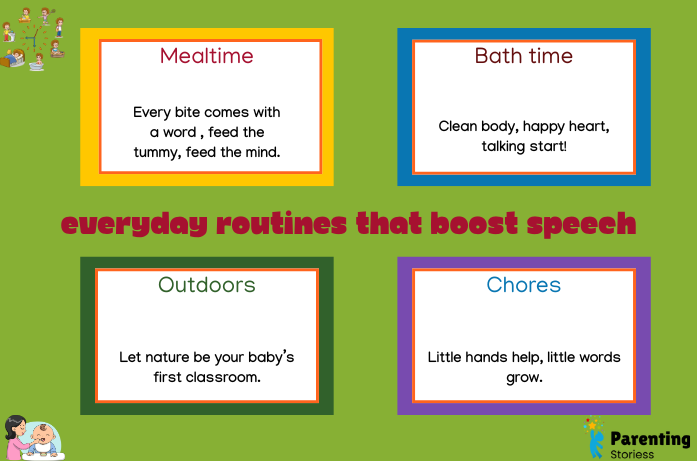
Everyday Routines that Boost Speech
Just 10–15 minutes of quality talking, reading, and play each day can make a big difference in your baby’s speech development.
Sometimes, parents worry about “fitting in” language activities. The truth is, opportunities are everywhere:
- Mealtime: Talk about textures and tastes. “This rice is soft.”
- Bath time: Label body parts, “Wash your toes, now your tummy.”
- Outdoors: Point out nature, “Look, a bird. The bird is flying.”
- Chores: Involve your baby, “Let’s fold clothes. Shirt, pants, socks.”
Common Mistakes Parents Make
Even the most caring parents sometimes miss small things that affect speech learning:
- Talking too little: Babies need to hear lots of words daily.
- Asking too many questions: Balance questions with comments and observations.
- Correcting harshly: Instead of “No, that’s wrong,” model the right word gently.
- Overusing baby talk: Playful tones are fine, but real words are more helpful in the long run.
When to Be Concerned About Speech Delays
Every child develops differently, but speech delay in babies red flags:
- By 6 months: Not babbling or responding to sounds.
- By 12 months: Not saying single words or using gestures.
- By 18 months: Fewer than 10 words, doesn’t imitate sounds.
- By 24 months: Not combining words; vocabulary under 50 words.
- At any age: Loss of skills, lack of response to name, little interest in interaction.
If you’re worried, consult your pediatrician. Sometimes hearing is the issue. Early evaluation, and when needed, speech therapy for infants, can help tremendously.
“Early action doesn’t necessarily mean something is wrong, it simply gives your child the best chance to thrive.” Programs such as Zero to Three’s Early Language Support emphasize that early response can make long-term communication stronger
Special Considerations
- Bilingual homes: Don’t worry, learning two languages doesn’t confuse babies. They may mix words at first, but bilingualism actually strengthens brain flexibility and problem-solving.
- Baby sign language: Teaching simple signs like “milk” or “more” can reduce frustration and support speech.
- Late talkers: Some children simply start later but catch up quickly. However, consistent delays across several areas should always be checked.
FAQs About Baby Speech Development
1. Do babies learn faster if I use two languages?
Yes. They may take a little longer to start speaking clearly, but bilingualism has long-term cognitive benefits.
2. Should I use baby sign language?
Yes, simple signs can help babies express needs before they can speak and may even support faster language development.
3. How much should I talk to my baby?
A lot! Babies benefit from thousands of words daily, but it doesn’t need to be forced. Just include them in conversations naturally.
4. What if my child isn’t talking yet but understands me?
Understanding often comes before speaking. Keep engaging, but check with a pediatrician if delays seem significant.
Final Thoughts
Speech development isn’t a race, it’s a journey filled with coos, babbles, first words, and eventually full conversations. Each stage is important, and every effort you make to talk, read, sing, and listen to your baby builds a foundation for communication, confidence, and learning.
Remember: the best tool for encouraging speech is you. Your voice, your expressions, your patience, and your love matter more than any gadget or program.
At Parenting Stories, we believe in celebrating these small but powerful moments. By encouraging speech through everyday play, conversations, and routines, you’re not just teaching words, you’re building a lifelong bond.
Disclaimer: This article is for informational purposes only. It does not replace professional medical advice. If you’re concerned about your child’s speech or hearing, consult your pediatrician.