
Written by a caring mom at Parenting Stories
When my baby turned 10 months, I often sat beside him watching him play happily. He was curious, smiling, and completely content, but not crawling. At the same time, I saw other babies moving around quickly, exploring everything, and I couldn’t help but wonder, “Why is my baby not crawling at 10 months?”
If you’re feeling this too, I understand. It’s never just about crawling, it’s about wanting your baby to be okay and doing your best as a parent. But here’s something gentle and reassuring: this phase is more common than you think, and in most cases, it’s far less worrying than it feels right now.
Understanding Baby Not Crawling at 10 Months
When you notice your baby not crawling at 10 months, it can feel like something is missing. We often see milestone charts or hear other parents talk, and suddenly it feels like our baby should be doing the same.
But baby development doesn’t work like a checklist.
Some babies crawl at 6 months, some at 9 or 10 months, and some don’t crawl at all. Yes, many babies completely skip crawling and move directly toward standing and walking. It may sound surprising, but it’s absolutely real and seen quite often.
What truly matters is not the crawling itself, but whether your baby is gradually building strength, curiosity, and awareness. If your baby is trying to reach, roll, sit, or explore in their own way, they are learning exactly what they need to.
Development is not about speed. It’s about progress, even the quiet, slow kind. According to NCBI studies like this one, babies can follow different movement paths and still develop normally.
Is It Normal If Your Baby Is Not Crawling Yet?
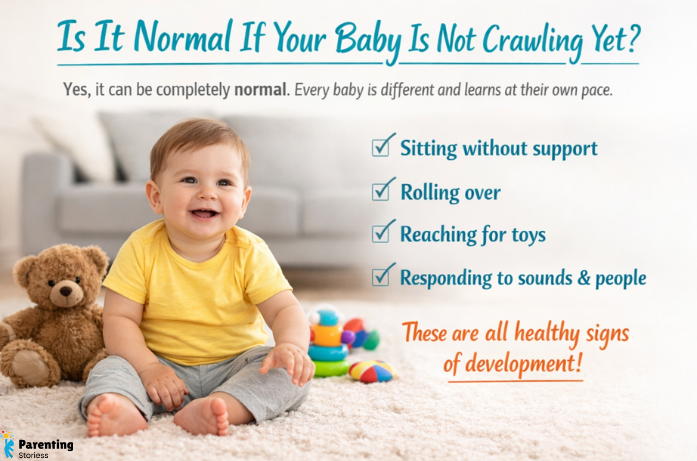
Yes, it can be completely normal if your baby is not crawling at 10 months. Babies develop at different speeds, and crawling does not begin at the same age for every child. Some babies start crawling early, while others crawl later, move by bottom-shuffling, roll to reach objects, or skip crawling altogether.
At around 10 months, your baby may be developing several important skills at the same time. While one baby may focus on crawling, another may spend more time improving balance, sitting, hand coordination, communication, or curiosity about the world around them.
Your baby may be showing healthy developmental progress if they are:
- Sitting without support
- Rolling in both directions
- Reaching for and holding toys
- Moving their arms and legs equally
- Responding to familiar sounds, faces, and voices
- Showing interest in nearby objects
These are encouraging signs that your baby is learning and growing. Crawling may simply happen a little later or in a different way. However, speak with your pediatrician if your baby cannot sit with support, rarely moves one side of the body, seems unusually stiff or floppy, or has lost a skill they previously learned.are all strong, healthy signs of development. Crawling may simply come a little later, or in a different form.
Baby Not Crawling at 9 Months: Still Within Normal Range
If your baby is not crawling at 9 months, it usually falls completely within the normal range. At this stage, babies are still figuring out how their bodies work.
Some babies roll everywhere instead of crawling. Some turn in circles while sitting. Others push themselves backward before learning to move forward. These small, almost playful movements are actually early practice.
What looks like “not progressing” is often preparation happening quietly.
Babies don’t suddenly wake up one day and crawl perfectly. They build toward it step by step, often in ways that are easy to miss if we’re only looking for one specific milestone.
Baby Not Crawling at 12 Months: When to Look a Little Closer
If your baby is not crawling at 12 months, it’s natural for concern to grow a bit stronger. This doesn’t mean something is wrong, but it does become a good time to observe your baby more carefully.
Some babies at this stage still don’t crawl traditionally. They may:
- Shuffle on their bottom
- Roll to move around
- Pull themselves up to stand
And many of these babies go on to walk normally.
However, if your baby is not attempting any movement at all, is unable to sit independently, or seems very stiff or unusually floppy, it’s a good idea to speak with a pediatrician. Not because you should panic, but because early guidance can be helpful if needed.
Sometimes, reassurance from a doctor is all you need to feel calm again. In fact, pediatric experts also explain that babies use different crawling styles or sometimes skip crawling entirely, which you can read more about here American Academy of Pediatrics,
Why Some Babies Don’t Crawl
One thing I wish someone had told me earlier is that there are many simple, natural reasons why a baby may not crawl.
Some babies have a calm and observant personality. They like to watch, understand, and feel secure before trying something new. These babies often take their time physically but can surprise you with sudden progress later.
Tummy time also plays an important role. Crawling requires strength in the arms, shoulders, and core. If a baby hasn’t spent much time on their tummy, they may need a little longer to build that strength.
Environment matters too. Babies who have space to move freely on the floor often explore more. On the other hand, too much time in walkers or seats can limit their chance to practice natural movements.
And sometimes, it’s simply about motivation. If everything your baby wants is always within reach, they may not feel the need to move toward it. Babies are curious, but they also need a little reason to explore.
Small Signs Your Baby Is Preparing to Crawl
Even if your baby is not crawling yet, there are often gentle signs that progress is happening.
You might notice your baby pushing up during tummy time or rocking slightly when placed on hands and knees. Some babies move backward first, which can feel confusing, but it’s actually part of learning coordination.
Others may pivot in circles, shift their weight, or stretch forward to grab something just out of reach. These movements may seem small, but they are incredibly important.
They show that your baby is learning balance, strength, and control, the exact skills needed for crawling.
How to Gently Encourage Your Baby
As a parent, it’s natural to want to help. And you can, in soft, simple ways that feel safe for your baby.
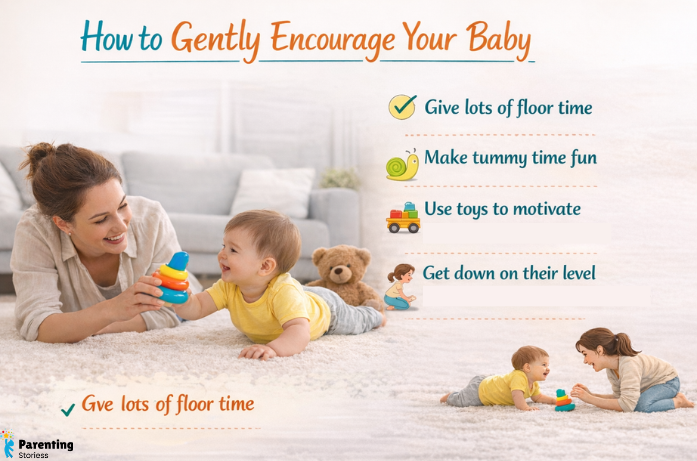
Giving your baby time on the floor every day can make a big difference. It allows them to move freely, explore their body, and try new positions without restriction.
Tummy time is still important, even at this stage. You can make it more enjoyable by lying down with your baby, talking to them, and making it feel like play instead of practice.
Sometimes, placing a favorite toy just a little out of reach can encourage movement. Not too far, just enough to spark curiosity.
And one of the most powerful things you can do is simply be there. Sit in front of your baby, smile, call their name, and cheer them on. Your presence gives them confidence.
The Emotional Side That No One Talks About
Let’s be honest for a moment.
When your baby is not crawling and others are, it doesn’t just stay a small thought. It can slowly turn into worry, comparison, and even self-doubt.
You might wonder if you’re doing something wrong. You might feel pressure without anyone actually saying anything.
I felt that too.
But over time, I realized something important, babies don’t compare themselves. They don’t know timelines or milestones charts. They just grow.
It’s we, as parents, who carry that weight.
Your baby is not behind. Your baby is simply on their own path.
When to Seek Guidance
Most of the time, there is nothing to worry about if your baby is not crawling at 10 months. But as a parent, your instinct matters.
If you feel something is not quite right, it’s always okay to check with a pediatrician. Especially if your baby is not moving at all, not sitting independently, or not showing interest in their surroundings.
Getting advice doesn’t mean something is wrong. It simply means you care enough to ask.
A Gentle Reminder You May Need Today
It’s easy to get caught in milestones. In numbers. In timelines.
But your baby is not a chart.
Some babies crawl early, some late, and some never crawl. Yet they all grow, learn, and become strong, active children.
What matters most is not when your baby crawls, but that they feel safe, loved, and supported as they grow.
And you are already giving them that.
Final Thought
If your baby is not crawling at 10 months, it’s okay to feel concerned. That concern comes from love, and love is what your baby needs most.
But try to hold onto this gently, development is not always loud and visible. Sometimes it happens quietly, slowly, and then all at once.
Keep giving your baby time. Keep encouraging without pressure. Keep trusting the process.
One day, your baby will start moving, maybe crawling, maybe scooting, maybe walking, and this phase will pass so quickly.
And you’ll look back and realize… everything was okay. Your baby is growing in their own beautiful way. And you are exactly the parent they need.
If this article gave you a little peace of mind, you’re not alone on this journey. Save it for later, share it with another mom who might be feeling the same, and keep visiting Parenting Stories for simple, honest support through every stage of your baby’s growth.
Frequently Asked Questions
Disclaimer
This article is based on personal experience and general parenting knowledge. It is not a substitute for professional medical advice. If you have concerns about your baby’s development, please consult your pediatrician for proper guidance.