
Written By a caring mom at Parenting Stories
Teaching responsibility does not happen in one big lesson. It grows through small everyday habits, simple chores, clear expectations, and letting children practice doing things for themselves. If you are wondering how to teach kids responsibility, the short answer is: start small, stay consistent, and give your child regular chances to help, make choices, and learn from mistakes.
As a mom, I have found that the little things matter most. Putting toys away, carrying a plate to the sink, remembering a school bag, or feeding a pet may seem simple, but these moments help children become more capable and dependable over time. They do not have to do everything perfectly responsibility grows with patience, practice, and guidance.
What Does Responsibility Mean for Kids?
For children, responsibility simply means learning to take care of their tasks, belongings, and choices. It can be as simple as putting toys away, finishing homework, caring for a pet, or being honest when they make a mistake.
A helpful responsibility definition for kids is: doing what you are expected to do and understanding that your choices have consequences. For younger children, you can explain it even more simply: “Responsibility means taking care of your jobs and your things.”
PBS KIDS for Parents explains that responsibility includes being dependable, making thoughtful choices, and taking accountability for your actions. What this looks like will naturally change with age, so the responsibilities given to a preschooler should be very different from those expected of an older child.
How to Teach Kids Responsibility in Everyday Life
Teaching responsibility does not need long lectures or strict rules. Children learn best when they get small chances every day to help, make choices, solve problems, and take care of their own tasks.
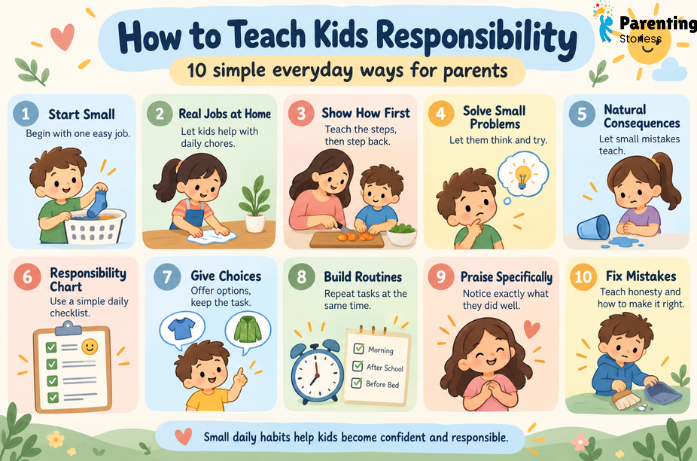
Here are 10 simple and practical ways parents can build responsibility at home.
1. Start With One Small Job
Begin with one simple task your child can manage on their own.
For a preschooler, this could be putting dirty clothes in the hamper. A school-age child might fill their water bottle or pack one part of their school bag.
Once that task becomes part of the routine, slowly add another. Small steps help children feel successful instead of overwhelmed.
2. Give Kids Real Jobs at Home
Children often feel proud when they know their help matters.
Depending on their age, they can:
- put toys away
- set napkins on the table
- carry dishes to the sink
- feed a pet
- water plants
- sort socks
- make the bed
- put clean clothes away
Children’s Hospital Colorado explains that responsibility is a skill children learn through practice, guidance, and watching adults. Giving them regular household jobs is one simple way to build that skill.
3. Show Them How Before Expecting Them to Do It Alone
Sometimes a task that feels simple to us can feel confusing to a child. Instead of only asking them to clean their room, break the job into smaller steps such as putting books on the shelf, blocks in the basket, and dirty clothes in the hamper.
Do the task together the first few times so your child understands what to do. As they become more confident, step back little by little and let them handle more of it on their own.
4. Let Them Solve Small Problems
It is easy to step in and fix every little problem, especially when you are in a hurry. But if the situation is safe, give your child a little time to think and work out what to do.
If they cannot find a library book or school item, help them think about where they last used it and what places they could check. This builds problem-solving skills and teaches them to take more responsibility for their belongings.
5. Use Natural Consequences
Not every mistake needs a punishment.
Sometimes the natural result is enough to teach the lesson.
If a child leaves a toy outside and it gets dirty, they can help clean it. If they forget a library book, they may need to wait before borrowing another.
Natural consequences help children understand that their choices have results without turning every mistake into an argument.
6. Create a Simple Responsibility Chart for Kids
Some children do much better when they can see what needs to be done.
A responsibility chart for kids can reduce constant reminders and make daily routines easier to follow.
| Morning | After School | Evening |
| Make bed | Put bag away | Put toys away |
| Brush teeth | Empty lunchbox | Put clothes in hamper |
| Pack water bottle | Finish homework | Prepare school bag |
For younger children, you can use pictures instead of words. Stickers, magnets, or check marks can also make the chart more fun.
American Academy of Pediatrics recommends age-appropriate chores and notes that charts or checklists can help children remember their jobs and see their progress.
7. Give Choices, but Keep the Responsibility
Children often cooperate better when they feel they have a little control. You can still keep the responsibility in place while giving them a simple choice about when or how to do it.
For example, let your child choose whether to put toys away before or after dinner, or whether they would rather feed the dog or water the plants. The task still gets done, but the small choice can make them feel more involved.
This can reduce arguments and help children practice making decisions while still learning that responsibilities need to be completed.
8. Build Responsibility Into Daily Routines
Tasks become easier to remember when they happen at the same time every day.
For example:
After breakfast → plate goes to the sink.
After school → shoes go away and lunchbox is emptied.
Before bed → toys are picked up and the school bag is checked.
Over time, the routine itself becomes the reminder.
This also means fewer repeated instructions for parents.
9. Praise What They Did Right
Instead of only saying “Good job,” try to be specific about what your child did well. You might say, “You remembered to feed the dog without me asking,” or “You put your school bag away as soon as you came home.”
Specific praise helps children understand exactly what responsible behavior looks like. It also shows them that their effort is noticed, which can encourage them to keep doing the same thing again.
PBS KIDS for Parents also encourages giving children age-appropriate responsibilities so they can feel useful, capable, and confident at home.
10. Teach Them to Fix Mistakes
Responsibility does not mean never making mistakes. Children will forget things, spill something, or make the wrong choice sometimes, and that is part of learning.
When your child admits a mistake, try to stay calm and ask, “What can we do to fix it?” You can also say, “Thank you for telling me. Let’s figure out what to do next.”
This teaches children that being responsible also means being honest, solving problems, and trying to make things right after something goes wrong.
Age-Appropriate Responsibilities for Kids
Every child develops differently, so use these as ideas rather than strict rules.
Ages 3–5
Young children may help with:
- putting toys away
- carrying dirty clothes to the hamper
- placing napkins on the table
- putting books on a shelf
- watering plants with help
Ages 6–8
Children may be ready to:
- make their bed
- feed pets
- pack a school bag
- clear their plate
- sort laundry
- help prepare simple snacks
Ages 9–12
Older children may begin:
- putting away their laundry
- helping prepare meals
- managing homework routines
- loading or unloading dishes
- cleaning parts of their room
- remembering items needed for school
The American Academy of Pediatrics emphasizes increasing household responsibilities as children mature while keeping expectations realistic.
The goal is not to keep children constantly busy with chores. It is to slowly teach the life skills they will eventually need without us standing beside them.
What If My Child Keeps Saying, I Forgot?
Children really do forget, especially when they are still learning a new routine. Before assuming they are being careless, check whether the task is simple, clear, and easy to remember.
Small changes can help a lot. Keep the backpack in the same place every day, use a checklist, or connect the task to a regular routine such as after school or before bedtime.
Over time, try to give fewer reminders. Instead of telling your child exactly what to do, ask what comes next in their routine. This encourages them to think for themselves and slowly become more independent.
What If My Child Refuses to Do Their Responsibilities?
Even cooperative children will sometimes refuse a task. Try to stay calm and keep the expectation simple rather than turning it into a long argument.
You can make the order clear by letting responsibilities come before certain privileges. For example, toys need to be put away before a movie, or the school bag should be ready before screen time.
The key is consistency. Children usually learn more from calm, repeated expectations than from threats, shouting, or constant negotiation.
Common Mistakes Parents Make
One common mistake is giving children tasks that are too difficult for their age and then feeling frustrated when they struggle. It also helps to avoid expecting perfect results while they are still learning.
Another mistake is giving too many reminders. If children know a parent will remind them again and again, they may start waiting for the next reminder instead of remembering on their own.
Try not to use chores only as punishment either. Household jobs work best when children see them as a normal part of family life and something everyone contributes to.
Responsibility Is More Than Chores
A child who makes their bed every morning is learning responsibility, but chores are only one part of it.
Responsibility also means:
- keeping promises
- treating other people’s belongings carefully
- admitting mistakes
- finishing schoolwork
- considering how choices affect others
- helping when someone needs support
- learning to manage time
As children grow, these skills become far more important than whether their bedroom was perfectly tidy at age six.
We are really teaching children, little by little, how to manage themselves.
Final Thoughts
Learning how to teach kids responsibility takes time, patience, and lots of small everyday practice. Start with simple tasks, clear routines, and chances for your child to solve little problems on their own.
A responsibility chart for kids can help with reminders, but what matters most is consistency. Your child will forget, complain, and make mistakes sometimes, and that is all part of learning.
Each time they remember a task, admit a mistake, or help without being asked, they are building skills they will use for years to come. Those small moments really do add up.
For more simple, practical parenting tips, explore more helpful guides on Parenting Stories.
Disclaimer
This article is for general parenting information only and is not a substitute for advice from a pediatrician, child development specialist, or other qualified professional. Every child develops differently, so use age-appropriate guidance that fits your child’s needs.