
Written by a caring mom at Parenting Stories
Pregnancy has a way of making you curious about every little thing happening inside your body. After seeing those two positive lines, one of the first moments many moms start looking forward to is hearing that tiny heartbeat for the first time. So, when can you hear a baby’s heartbeat?
The short answer is: early cardiac activity may sometimes be seen on a transvaginal ultrasound around 5½ to 6 weeks, while a baby’s heartbeat is more commonly heard with a handheld Doppler around 10 to 12 weeks or later. Still, every pregnancy is a little different, and even a few days can affect what your doctor is able to see or hear at an early appointment.
When Can You Hear a Baby’s Heartbeat?
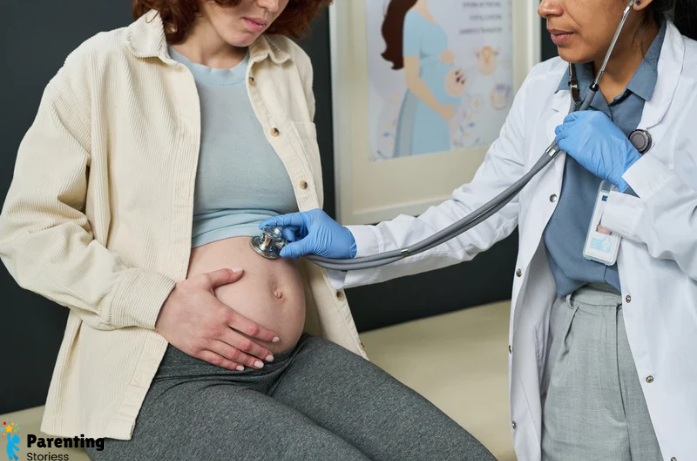
A healthcare provider may be able to hear your baby’s heartbeat with a handheld fetal Doppler at around 10 to 12 weeks of pregnancy.
Sometimes it can be detected earlier, and sometimes it takes a little longer.
This can depend on:
- how accurately your pregnancy is dated
- your baby’s position
- the position of your uterus
- the equipment being used
- your individual body
It is also important to know that seeing cardiac activity on ultrasound is different from hearing a heartbeat with a Doppler.
You may see that tiny flicker on a scan weeks before you hear the heartbeat during a prenatal visit.
Quick Baby Heartbeat Timeline
Here is a simple guide:
| Pregnancy Stage | What You May Expect |
| Around 5–6 weeks | Early cardiac activity may begin and sometimes be seen on ultrasound |
| Around 6–7 weeks | Cardiac activity often becomes easier to detect |
| Around 8–10 weeks | Heart activity usually becomes clearer on ultrasound |
| Around 10–12 weeks | A Doppler may begin detecting the heartbeat |
| Around 18–22 weeks | Baby’s heart is examined more closely during the anatomy scan |
These are general timelines, not strict deadlines. Every pregnancy can develop a little differently.
When Does Baby Heartbeat Start?
Your baby’s heart begins developing very early in pregnancy, but it does not appear fully formed all at once. Tiny cells gradually come together to create the structures that will later become the heart and circulatory system.
By around five to six weeks, early cardiac tissue may begin to contract, and this can sometimes appear as a small flicker on an ultrasound. At this stage, doctors may describe it as embryonic cardiac activity because the heart is still developing.
According to a review published in the National Library of Medicine (PMC), ultrasound studies have shown that detectable embryonic heart activity can begin during the early weeks of development, although the exact timing can vary between pregnancies.
Over the following weeks, the chambers, valves, and blood vessels continue to form and mature. For many parents, seeing that first tiny flicker is an unforgettable moment.
When Does Fetal Heartbeat Start?
In the earliest weeks of pregnancy, your developing baby is still called an embryo, and the fetal stage begins later. Even so, heart development starts very early and progresses quickly during those first weeks.
Cardiac activity may sometimes become visible on an ultrasound at around six weeks. From there, the heart continues to grow and develop throughout pregnancy as its structure becomes more mature.
When Can You See Heartbeat on Ultrasound?
If you’re wondering when can you see heartbeat on ultrasound, the answer depends on the type of scan.
Transvaginal Ultrasound
A transvaginal ultrasound may sometimes detect cardiac activity at around 5½ to 6 weeks.
Because the probe is closer to the uterus, it can provide a clearer view during very early pregnancy.
Your provider may recommend this type of scan if:
- your pregnancy is very early
- your dates are uncertain
- you have bleeding or pain
- there is concern about an ectopic pregnancy
- your pregnancy followed fertility treatment
Abdominal Ultrasound
An abdominal ultrasound is performed by moving a probe across your belly.
During the earliest weeks, everything is still tiny, so it may not show as much detail as a transvaginal scan.
As pregnancy progresses, abdominal ultrasound becomes much more useful.
This is one reason one mom may see cardiac activity at six weeks while another sees it a little later.
Why Your Pregnancy Dates May Be Off
This is something every newly pregnant mom should know.
Pregnancy is usually dated from the first day of your last menstrual period, not from the actual day of conception.
That system assumes ovulation happens around the middle of your cycle.
But real cycles don’t always work that way.
You may have:
- ovulated later than expected
- had irregular cycles
- had a longer cycle
- forgotten the exact date of your last period
- conceived later than you assumed
So you might think you’re 6 weeks and 3 days pregnant when the pregnancy is actually measuring several days younger.
During early pregnancy, those few days can make a big difference.
What If There Is No Heartbeat at 6 Weeks?
Not seeing cardiac activity at a six-week ultrasound can feel worrying, but it does not always mean there is a problem. Sometimes the pregnancy is simply earlier than expected, especially if ovulation happened later or the dates are not exact.
Your healthcare provider may look at the gestational sac, yolk sac, embryo size, symptoms, and pregnancy dates before deciding what the scan means. In many cases, they may suggest a repeat ultrasound after some time has passed, and sometimes blood tests are used for more information.
Try not to judge your pregnancy from one early scan or compare it with someone else’s experience online. Early pregnancy can change quickly, and your doctor will look at the complete picture before giving you an answer.
When Can You Hear Baby Heartbeat With a Doppler?
A handheld fetal Doppler is usually used later than an early ultrasound. In many pregnancies, a doctor or midwife may be able to detect the baby’s heartbeat at around 10 to 12 weeks, although the timing can vary.
During the check, your provider places a small amount of gel on your abdomen and gently moves the Doppler until the heartbeat is found. Sometimes it is picked up quickly, while other times it may take a little longer because of your baby’s position or how early the pregnancy is.
If the heartbeat is not found right away, try not to panic. Early Doppler checks can be tricky, and your healthcare provider will decide whether to try again later or use another method if needed.
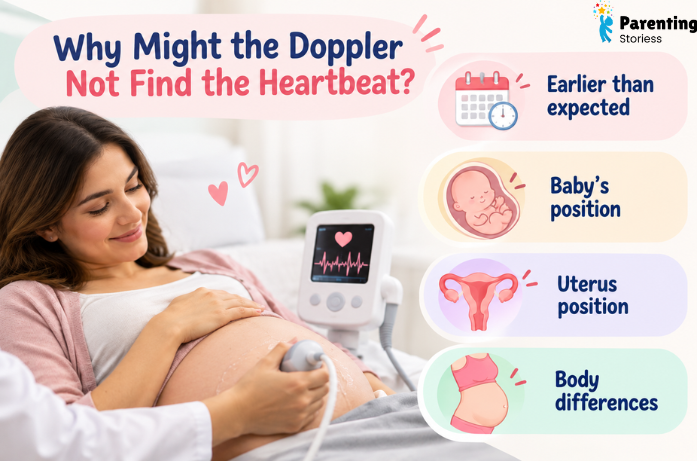
Why Might the Doppler Not Find the Heartbeat?
There are a few common reasons a heartbeat may be harder to detect early in pregnancy:
You may be earlier than expected: If your dates are off by even a few days, your baby may still be too small for the Doppler to pick up easily.
Baby’s position: Your baby may be lying in a spot that makes the heartbeat harder to find.
Uterus position: The position or tilt of your uterus can affect how clearly the Doppler detects the heartbeat.
Body differences: Every body is different, and the distance between the Doppler and uterus can sometimes make the signal less clear.
If the heartbeat is not found right away, try not to worry. Your healthcare provider may simply try again later or recommend another check if needed.
Is That My Heartbeat or the Baby’s?
During a Doppler check, you may hear more than one sound, including your own pulse, blood flow, placental sounds, and your baby’s heartbeat. It can be difficult to tell the difference on your own, especially if you are using a home Doppler.
A baby’s heartbeat is usually much faster than an adult pulse, and many parents describe the sound as similar to tiny galloping horses. A trained healthcare professional can identify the different sounds and measure the fetal heart rate correctly, which is why professional checks are more reliable.
What Is a Normal Baby Heart Rate?
Your baby’s heart rate changes throughout pregnancy.
Later in pregnancy, a commonly referenced fetal heart-rate range is around 110 to 160 beats per minute, although it can naturally change with movement and development.
Johns Hopkins Medicine explains that the average fetal heart rate is generally between 110 and 160 beats per minute, although it can vary as your baby responds to changes inside the uterus.
Your provider will not judge your baby’s health from one number alone.
They also consider gestational age, rhythm and overall development.
So try not to compare your baby’s heart rate with someone else’s.
Can Heart Rate Predict Baby’s Gender?
You’ve probably heard the old pregnancy belief that a fast heartbeat means a girl and a slower heartbeat means a boy.
It is a fun guessing game, but fetal heart rate is not a reliable way to predict your baby’s sex.
Heart rate changes naturally during pregnancy and can also vary depending on whether baby is moving or resting.
So enjoy the guessing, but don’t rely on the Doppler number for your answer.
Should You Use a Home Fetal Doppler?
I completely understand why home Dopplers are tempting.
Pregnancy comes with so much waiting, and being able to listen at home may sound reassuring.
But sometimes it creates more anxiety instead.
If you can’t find the heartbeat, you may panic even when everything is fine.
You might also mistake your own pulse or another sound for your baby’s heartbeat.
Most importantly, never use a home Doppler to decide whether you need medical care.
If you have bleeding, severe pain, dizziness or other worrying symptoms, contact your healthcare provider even if you think you can hear a heartbeat.
What Happens After You Hear the Heartbeat?
Hearing your baby’s heartbeat for the first time is a special milestone, but the heart keeps developing throughout pregnancy. Your healthcare provider may continue checking the heartbeat during future prenatal visits.
Later, usually around 18 to 22 weeks, the anatomy scan gives a closer look at your baby’s heart and other developing organs. If your provider needs more detail, they may recommend a fetal echocardiogram, though this is usually only needed for specific medical reasons.
How to Prepare for Your First Heartbeat Appointment
You don’t need to do anything complicated, but a little preparation can make the visit feel easier.
Try to know the first day of your last period and your usual cycle length if possible.
Ask whether you are having a transvaginal or abdominal ultrasound, especially if your appointment is early.
You may also want to keep a few questions in your phone, such as:
- How far along am I measuring?
- Is development appropriate for this stage?
- Was cardiac activity detected?
- When will you check the heartbeat again?
- When is my next ultrasound?
There are no silly questions during pregnancy.
When Should You Call Your Doctor?
Some mild symptoms can happen during early pregnancy, but certain signs deserve medical attention.
Contact your healthcare provider if you experience:
- vaginal bleeding
- worsening cramps
- severe abdominal or pelvic pain
- fluid or tissue passing from the vagina
- severe dizziness
- fainting
- any symptom that feels unusual or worrying
Seek urgent medical care for heavy bleeding, severe pain or fainting.
Never rely on a home Doppler to rule out a problem.
Frequently Asked Questions
1. Can you hear a heartbeat at 6 weeks pregnant?
Usually, six weeks is too early for a handheld Doppler. However, cardiac activity may sometimes be visible on a transvaginal ultrasound.
2. Can you hear a baby heartbeat at 8 weeks?
An ultrasound may detect cardiac activity by eight weeks, but a handheld Doppler may still be too early.
3. When can you see heartbeat on ultrasound?
Cardiac activity may sometimes be visible on a transvaginal ultrasound at around 5½ to 6 weeks.
4. When can you hear baby heartbeat with a Doppler?
A healthcare provider may be able to detect it around 10 to 12 weeks or later.
5. Is it normal not to hear a heartbeat at 10 weeks?
Yes, it can happen. Your pregnancy dates, baby’s position, uterus position and other factors can make an early Doppler check difficult.
Final Thoughts
So, when can you hear a baby’s heartbeat? Early cardiac activity may sometimes be seen on ultrasound around six weeks, while a handheld Doppler may detect the heartbeat around 10 to 12 weeks or later.
Every pregnancy follows its own timeline, so try not to worry if things happen a little earlier or later than expected. Your healthcare provider can guide you based on your dates, scan results, and overall pregnancy.
Those first weeks can feel full of excitement and worry, but take it one appointment at a time. Hearing or seeing that tiny heartbeat can become one of the sweetest moments of pregnancy.
For more simple, supportive pregnancy and parenting tips, explore more helpful guides on Parenting Storiess.
Medical Disclaimer
This article is for general educational purposes only and is not a substitute for medical advice, diagnosis or treatment. Always contact your OB-GYN, midwife or another qualified healthcare professional if you have concerns about bleeding, pain, ultrasound results or your baby’s heartbeat.