
Written By a caring mom at parenting Stories
Have you ever noticed how your toddler can spend more time playing with an empty cardboard box than an expensive toy? These simple moments are more than just fun. They give children opportunities to explore their imagination, develop problem-solving skills, and learn about the world around them.
Child led play is a simple approach where children choose what they want to play, how they want to explore, and what happens next. Instead of directing every activity, parents follow their child’s interests while providing gentle guidance and a safe environment.
The best part? You don’t need expensive toys or complicated activities to encourage it. In this guide, we’ll explore the benefits of child led play, easy activities for different ages, and practical ways to support your child’s creativity, confidence, and learning through everyday play.
What Is Child-Led Play?
Child-led play is when children choose what they want to play, how they want to play, and how their activities unfold.
Instead of adults giving instructions, children follow their interests and imagination.
For example, you give your toddler colorful blocks, expecting them to build a tower. But they arrange the blocks in a line and pretend it’s a train.
Rather than correcting them, you follow their idea.
You might say, “Wow, your train is getting longer!”
According to the Raising Children Network, following children’s interests during play supports their learning and development.
The goal isn’t to teach something new every minute. It’s to give children opportunities to explore, experiment, and enjoy discovering things themselves.
Why Is Child-Led Play Important?
Children learn naturally through play. Simple activities like stacking blocks, pretending to cook, or exploring toys help them develop creativity, communication, and problem-solving skills.
One of the biggest benefits of child led learning is that children can follow their interests, make their own choices, and explore new ideas at their own pace. This helps build confidence and independence.
For example, a toddler may repeatedly build and knock down a tower, while a preschooler creates imaginary stories. These everyday experiences support learning and development in a fun, meaningful way.
8 Wonderful Benefits of Child-Led Play
The benefits of child led play go beyond keeping children entertained. It gives little ones opportunities to explore, make decisions, and develop important skills through everyday activities. Here are eight wonderful ways it supports your child’s growth.
1. Builds Confidence and Independence
Have you noticed how proud your toddler looks after completing a puzzle or building a tower without help? These small achievements can make children feel capable and confident.
Child-led play encourages children to make their own choices and try new things. Instead of immediately helping, give your child a little time to figure things out independently.
2. Encourages Creativity and Imagination
Children can turn almost anything into an adventure. A cardboard box becomes a spaceship, a blanket turns into a tent, and a wooden spoon becomes a magic wand.
When children direct their own play, they can explore ideas freely without worrying about doing things correctly. Simple materials like blocks, crayons, and playdough can encourage their imagination.
3. Develops Problem-Solving Skills
Imagine your toddler building a block tower that keeps falling. Instead of showing them the correct way, allow them to experiment with different arrangements.
These little challenges help children practice thinking, patience, and finding solutions. You can gently encourage them by asking, “What else could we try?”
4. Supports Emotional Development
Young children don’t always have the words to explain their feelings, but pretend play gives them another way to express themselves.
For example, your child might comfort a crying doll or pretend to examine a teddy bear after visiting the doctor. These playful experiences can help them explore emotions and understand familiar situations.
5. Improves Communication and Language Skills
Child-led activities naturally encourage children to communicate. A toddler might point toward a toy, while a preschooler explains an imaginary story.
When you respond to their ideas, children get opportunities to practice language. Instead of asking too many questions, describe their actions, such as, “You’re driving the blue car through the tunnel!”
6. Encourages Focus and Persistence
Have you ever watched your child repeatedly fill a container with water or arrange toy animals? Although it may look simple, they’re exploring how things work.
When children choose activities they enjoy, they may stay focused longer and become more willing to try again after difficulties. Allow them to continue exploring without unnecessary interruptions.
7. Develops Social Skills and Cooperation
Playing with siblings or friends helps children practice sharing, taking turns, and working together.
For example, two preschoolers running a pretend restaurant might decide who cooks and who serves food. If disagreements happen, gently help them express their ideas and find a solution together.
8. Strengthens the Parent-Child Bond
One of the most meaningful child led play benefits is the opportunity to build a stronger connection with your little one.
When you follow your child’s imagination, listen to their ideas, and enjoy playing together, they feel valued and supported. The CDC’s child-led play guidance also encourages praise, imitation, description, and active listening during playtime.
Even five minutes of focused, loving attention can make everyday playtime more meaningful.
Child-Led Play Examples by Age
Child-led play looks different as children grow. The important thing is choosing safe, age-appropriate materials and following their interests.
Child-Led Play for Babies (0–12 Months)
Babies communicate their interests through movements, sounds, facial expressions, and eye contact.
If your baby reaches toward a soft toy, allow them to explore it safely rather than immediately offering something different.
Try these simple activities:
- Responding to your baby’s coos and babbles.
- Offering safe toys they’re looking toward.
- Copying their facial expressions.
- Letting them explore baby-safe textures.
- Following their interests during supervised tummy time.
Watch for signs of tiredness and allow breaks whenever needed.
Child-Led Play for Toddlers (1–3 Years)
Toddlers love discovering what everyday objects can do.
You might notice your child repeatedly opening containers, pushing toy cars, or carrying objects around the room.
Some easy child led activities include:
- Building with large blocks.
- Playing with stacking cups.
- Drawing with chunky crayons.
- Pretending to cook.
- Exploring water with cups under close supervision.
Let your toddler decide how to use the materials safely.
Child-Led Play for Preschoolers (3–5 Years)
Preschoolers often enjoy imaginative stories and pretend play.
They might create imaginary shops, build houses, or pretend to be teachers.
Try offering:
- Dress-up clothes.
- Puppets and stuffed animals.
- Cardboard boxes.
- Building materials.
- Paper and art supplies.
- Nature exploration opportunities.
Allow your child to decide what happens next instead of directing the story.
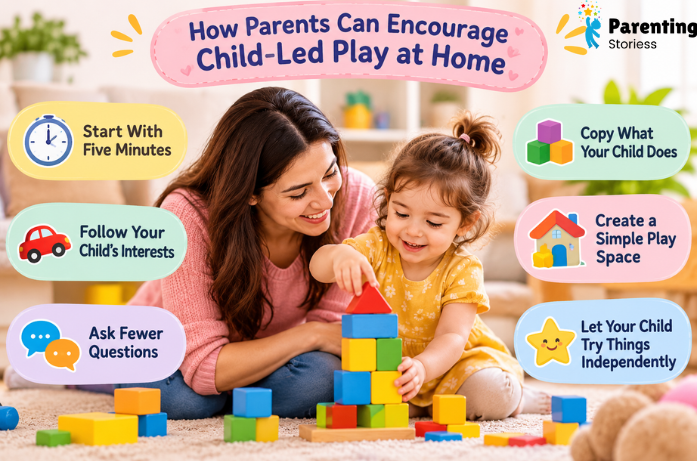
How Parents Can Encourage Child-Led Play at Home
Encouraging child led play doesn’t require expensive toys or special activities. A few simple changes in your daily routine can help your child explore, learn, and enjoy playtime more freely.
1. Start With Five Minutes
You don’t need to spend hours playing with your child. The CDC suggests starting with at least five minutes of focused playtime each day.
Choose a quiet moment, put your phone away, and let your child pick an activity. Give them your full attention without trying to control the game.
2. Follow Your Child’s Interests
Let your child decide what they want to play instead of choosing an activity for them.
For example, if your toddler enjoys playing with toy cars, sit beside them and join their game. If they pretend the car is flying, play along rather than correcting them.
3. Ask Fewer Questions
As parents, we often ask questions like “What color is this?” or “How many blocks do you have?” But too many questions can make playtime feel like a lesson.
Instead, talk about what your child is doing. You might say, “Wow, you’ve built a long road!” This encourages natural conversation without interrupting their imagination.
4. Copy What Your Child Does
Children love it when parents join their little adventures. If your child rolls a toy car, roll another one beside them.
If they pretend to feed a doll, you can do the same with another toy. Copying their actions shows you’re interested in their ideas while allowing them to lead.
5. Create a Simple Play Space
You don’t need a big playroom or lots of toys. A small, comfortable corner with blocks, books, crayons, and pretend-play toys is enough.
Keep age-appropriate toys where your child can easily reach them. You can also change a few toys occasionally to keep playtime interesting.
6. Let Your Child Try Things Independently
It’s natural to want to help when your child struggles, but give them a little time to figure things out.
If their block tower falls or a puzzle piece doesn’t fit, encourage them to try again. You can gently ask, “Would you like some help?” These small experiences help children build confidence and problem-solving skills.
Child-Led Play vs. Adult-Led Play
Both approaches can support children’s learning, but they work differently.
| Child-Led Play | Adult-Led Play |
| Child chooses the activity | Adult chooses the activity |
| Child decides how to explore | Adult provides instructions |
| Encourages free exploration | Often focuses on a learning goal |
| Allows flexible outcomes | May have expected results |
| Parent observes and supports | Parent directs the activity |
For example, allowing your child to build anything with blocks is child-led play.
Showing them how to build a particular structure is adult-led play.
Neither approach is always better. Children can benefit from a healthy balance of free exploration and guided activities.
What If Your Child Doesn’t Want to Play Independently?
It’s normal for toddlers to want their parents nearby during playtime. Remember, child-led play and independent play are different. Child-led play means your child chooses the activity, while independent play means they play without your active involvement.
If your child wants you to join, start by playing together and gradually encourage short periods of independent play while staying close. Every child develops at their own pace, so there’s no need to rush or force independence.
When Should Parents Step In During Child-Led Play?
Allowing children freedom doesn’t mean removing boundaries.
Parents should intervene when something becomes unsafe or harmful.
For example, step in if your child:
- Climbs unstable furniture.
- Puts unsafe objects into their mouth.
- Throws hard toys at someone.
- Hurts another child.
- Becomes overwhelmed and needs comfort.
You can set boundaries without taking away your child’s creativity.
For example, “Blocks are for building. If you want to throw something, let’s use this soft ball.”
Child-led play works best when children feel free to explore within safe, loving limits.
Frequently Asked Questions About Child-Led Play
1. What is an example of child-led play?
A toddler choosing blocks and deciding to build a pretend road is an example. The parent follows the child’s ideas rather than giving instructions.
2. At what age can child-led play begin?
It can begin during infancy. Parents can follow their baby’s gaze, movements, sounds, and interest in safe objects.
3. How long should child-led play last?
There’s no fixed duration. Start with five minutes of focused play and gradually increase the time according to your child’s interest.
4. Is child-led play better than structured play?
Both have benefits. Child-led play encourages exploration and independence, while structured activities can help children practice specific skills.
5. What if my child always chooses the same activity?
Repetition is common in early childhood. Children often enjoy practicing familiar skills and discovering new details through repeated play.
Final Thoughts
As parents, we want our children to learn, grow, and feel confident. But meaningful learning doesn’t always need planned activities or expensive toys. Sometimes, simply letting children explore and follow their curiosity is enough.
Child led play gives little ones opportunities to build creativity, independence, and problem-solving skills while enjoying everyday activities. Your encouragement and loving presence make these moments even more special.
At Parenting Stories, we believe every child deserves the freedom to play, discover, and grow at their own pace. So, follow your child’s lead, enjoy those little moments, and remember that learning can happen through the simplest playtime adventures.