
Written by caring mom at Parenting Stories
Tummy time may look simple, but it is important work for a young baby. Lying on the tummy helps babies use their neck, shoulder, back, and arm muscles, which later support skills such as rolling, sitting, reaching, and crawling.
If your baby fusses or becomes tired quickly, that is quite common in the beginning. Trying different tummy time positions, such as on your chest, across your lap, or on a firm play surface, can make tummy time feel more comfortable and less frustrating.
You do not need to aim for long sessions. Short, supervised tummy-time moments throughout the day are often easier for babies. Watch your baby’s cues, give breaks when needed, and remember that even small head lifts and little pushes through the arms are useful practice.
Why Is Tummy Time Important?
Tummy time gives your baby a chance to practice using important muscles while they are awake and supervised. Lifting and turning the head, pushing through the arms, and holding the upper body up all help build strength in the neck, shoulders, back, and arms.
These early movements support later skills such as reaching, rolling, sitting, crawling, and exploring the world around them. It also gives the back of your baby’s head a break from constant pressure, which may help reduce flat spots.
The NHS Best Start in Life explains that tummy time can begin from birth, including while your baby rests on your chest when you are awake. Even short sessions and tiny head lifts are useful practice as your baby gradually becomes stronger.
When Can You Start Tummy Time?
For most healthy babies, tummy time can start from the early newborn days. In the beginning, it does not need to happen on the floor or last for several minutes.
You can start with a short tummy-down cuddle on your chest or across your lap while your baby is awake and you are watching closely. As your baby becomes stronger and more comfortable, you can slowly add more floor tummy time.
The American Academy of Pediatrics recommends beginning with short sessions and gradually increasing them over time. Instead of focusing too much on the clock, follow your baby’s cues and aim for several calm, manageable sessions throughout the day.
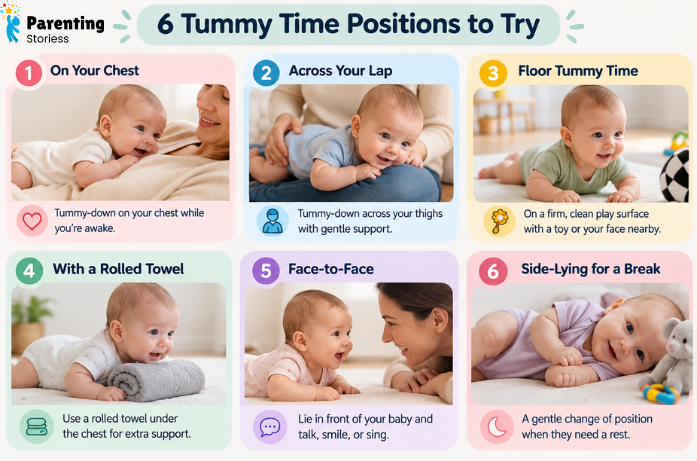
6 Tummy Time Positions to Try
There is no single best position for tummy time. Some babies are happy on the floor from the start, while others feel more comfortable beginning on a parent’s chest or lap. Trying a few different positions can help you find what works best for your baby.
1. Tummy Time on Your Chest
Chest-to-chest tummy time is a gentle way to start, especially with a newborn.
Lean back in a comfortable position while you are fully awake, then place your baby tummy-down on your chest. Keep their face turned to the side or lifted so their nose and mouth stay clear.
Talk, smile, or sing softly to encourage your baby to look toward you. Even a brief attempt to lift the head is useful practice.
This position can feel reassuring because your baby is still close to your warmth, voice, and heartbeat.
2. Tummy Time Across Your Lap
Your lap can be another comfortable option when your baby is not ready for much floor time.
Sit securely and place your baby tummy-down across your thighs. Support their body as needed and make sure their face stays clear.
You can gently rub their back, talk to them, or encourage them to turn their head from one side to the other.
This position works well for short sessions and can easily fit into your normal daily routine.
3. Floor Tummy Time
A firm floor surface gives your baby plenty of space to move and practice.
Place your baby on their tummy on a clean play mat or thin blanket, then get down beside them. Your face, voice, or a simple toy can encourage them to lift and turn their head.
Try moving yourself or a toy slowly from side to side so your baby has something interesting to follow.
Avoid soft beds, sofas, or thick cushions, as these surfaces can make movement harder and may create safety risks.
4. Tummy Time With a Rolled Towel
If your baby struggles to lift their chest from the floor, a small rolled towel may offer a little extra support.
Place the towel under the upper chest and bring your baby’s arms forward so they can rest on their forearms. Stay close and make sure their face is always clear.
The slight lift can make it easier for some babies to look around and practice using their neck and shoulder muscles.
Both the NHS and the American Academy of Pediatrics mention rolled-towel support as an option for babies who find regular tummy time difficult.
5. Face-to-Face Tummy Time
Sometimes the easiest way to keep your baby interested is to join them on the floor.
Lie on your stomach in front of your baby and bring your face close to their level. Smile, copy their sounds, sing a song, or simply talk to them.
Babies are naturally drawn to familiar faces, so seeing you nearby may encourage them to lift their head for longer.
This can make tummy time feel more like play and connection instead of a daily exercise.
6. Side-Lying for a Short Break
Side-lying is not a replacement for tummy time, but it can be a helpful break for babies who become frustrated quickly.
Lay your baby on their side on a firm play surface while you stay close. Their hands can come together in front of them, making it easier to look at or reach toward a toy.
A few minutes in this position can give your baby a chance to rest before you try tummy time again later.
It is especially useful when your baby has had enough of being tummy-down but still wants to play and move.
Tummy Time Positions by Age
The way your baby enjoys tummy time will often change as they grow stronger and more confident.
In the newborn stage, tummy time on your chest or across your lap may feel most comfortable. By around one to two months, you can begin adding more time on a firm play surface, with gentle support such as a rolled towel if needed.
By two to three months, many babies start lifting their head higher and pushing up on their forearms. Around four to five months, tummy time may become more active, with reaching, shifting weight, and early rolling attempts.
By six months and beyond, tummy time usually blends naturally into everyday floor play. Your baby may roll, pivot, reach for toys, and begin moving around more independently.
These stages are only general guidelines. Babies develop at different speeds, so focus more on steady progress than on reaching each skill at an exact age.
What If My Baby Hates Tummy Time?
Some babies need more time to get comfortable with tummy time, especially in the early weeks. If your baby fusses as soon as you place them on the floor, it may simply mean that position feels difficult right now.
Try changing the setup instead of forcing the same routine. You can use your chest, your lap, a rolled towel for gentle support, or lie face-to-face with your baby. Short sessions are perfectly fine.
If your baby becomes very upset, pick them up, comfort them, and try again later. A few calm, one- or two-minute sessions throughout the day can be much easier than one long session filled with tears.
Know When Your Baby Needs a Break
You do not have to wait until your baby is fully crying before ending tummy time.
Watch for early signs of tiredness, such as the head dropping more often, slower or less controlled movements, turning the face down, or fussing that gradually becomes stronger.
When you notice these signs, take a break and cuddle your baby. Ending the session before they become completely frustrated can help keep tummy time a more positive experience.
When Is the Best Time for Tummy Time?
The best time is usually when your baby is awake, calm, and comfortable.
Many parents find it helpful to add tummy time to routines that are already part of the day, such as after a diaper change or after waking from a nap.
Try to avoid starting when your baby is very hungry, sleepy, or already upset. A relaxed baby is often more interested in looking around, lifting their head, and interacting with you.
Can You Do Tummy Time After Feeding?
It is usually better not to place your baby tummy-down immediately after a full feed.
Pressure on a full stomach may make some babies uncomfortable and can lead to more spit-up or fussiness.
Give your baby time to settle after feeding and keep them upright if they need it before trying tummy time. There is no exact waiting time that works for every baby, so follow your baby’s usual feeding and spit-up patterns.
If your baby has reflux, frequent vomiting, feeding difficulties, or seems uncomfortable during tummy time, ask your pediatrician for advice that fits your baby’s needs.
Easy Ways to Make Tummy Time More Fun
Tummy time does not need lots of special toys. Your face and voice are often enough to keep your baby interested.
Get down at eye level, smile, sing, make gentle sounds, or talk to your baby. You can also place a baby-safe mirror, colorful board book, or simple toy nearby.
As your baby grows stronger, move toys slightly to one side to encourage head turning, reaching, and shifting weight.
Keeping tummy time playful can make it feel more like bonding and less like an exercise session.
Common Tummy Time Mistakes to Avoid
Try not to compare your baby with other babies or expect every session to last the same amount of time. Some babies build tolerance quickly, while others need many short sessions.
Using only one position can also make tummy time harder than it needs to be. If your baby dislikes floor tummy time, try your chest, lap, or another safe position before returning to the floor.
Most importantly, tummy time is only for awake, supervised play. Stay close, keep your baby’s face clear, and never use tummy time as a sleeping position.
For sleep, babies should be placed on their backs following safe-sleep guidance from the American Academy of Pediatrics.
When Should You Ask the Pediatrician?
Every baby develops at their own pace, but you should mention concerns to your pediatrician if something does not feel right.
Ask for advice if your baby seems unusually stiff or floppy, appears to be in pain, always turns their head to one side, has trouble moving their neck, or is not making progress with head control.
A strong preference for looking in one direction can sometimes be connected with a tight neck condition such as torticollis.
You should also ask for personalized tummy-time guidance if your baby was born prematurely or has feeding, breathing, orthopedic, reflux, or developmental concerns.
Quick Tummy Time Questions
1. Does tummy time on my chest count?
Yes. Supervised tummy-down time on your chest while you are awake can be a good tummy-time position, especially for newborns.
2. Does tummy time have to happen on the floor?
No. Babies can also do tummy time on a parent’s chest or lap. Floor tummy time becomes more useful as your baby gets stronger and needs more room to move.
3. Is it normal if my baby cries during tummy time?
Some fussing is common because tummy time can be tiring. You can stop, comfort your baby, and try again later if they become very upset.
4. What if my baby falls asleep?
Move your baby to a safe sleep space and place them on their back. Tummy time is only for awake, supervised play.
Final Thoughts
Finding comfortable tummy time positions can make this stage easier for both you and your baby. Short, supervised sessions can help your baby build strength in the neck, shoulders, arms, and upper body while preparing for later skills such as rolling and sitting.
If one position for tummy time does not work well, try another and follow your baby’s cues. Some babies need more time to feel comfortable, and that is completely normal. Regular practice matters more than having a long or perfect session.
Explore more baby development and newborn-care tips on Parenting Stories to feel more confident through every little milestone.
Disclaimer
This article is for general informational purposes only and is not a substitute for medical advice. Always speak with your pediatrician if you have concerns about your baby’s development, feeding, movement, or tummy-time tolerance.