

Written by a caring mom at Parenting stories
When your child is a toddler not listening to you, there is a high probability that you have been through the experience of having to ask your toddler to do something more than once without getting a positive response. It can be as simple as asking your toddler to put his/her shoes on, clean up their toys or come to the dinner table.
There are various factors why the child seems not to listen to what you are saying. These include among others the child’s short attention span, developing language, impulsive nature, emotional reactions, and increasing desire for independence.
Why Is My Toddler Not Listening?
Toddlers are not simply miniature adults who understand everything we say and choose not to listen. At this age, their brains are still developing important skills such as attention, memory, language, emotional control, and self-regulation. At the same time, they are becoming more independent and beginning to form their own preferences and opinions. Johns Hopkins Medicine explains that toddlers often seek more independence and autonomy, which can sometimes appear as refusal, limit testing, or not listening.
Because of this, listening and following directions can sometimes be difficult. Even when a toddler understands what you are asking, they may struggle to stop playing, manage frustration or disappointment, and complete the task. These challenges are a normal part of learning and growing during the toddler years.
They May Be Too Focused on Something Else
Toddlers can become deeply absorbed in play. If they are building blocks, drawing, watching something, or pretending with toys, their attention may be completely focused on that activity.
Calling instructions from another room may barely register. Instead of repeating yourself louder, walk closer, gently get their attention, and then give the direction. Connection first often works better than volume.
Your Toddler May Hear You but Still Struggle to Follow Through
Listening is much more than simply hearing words. For a toddler to follow a direction, they may need to stop what they are doing, shift attention, understand the instruction, remember it, manage their emotions, and complete the task.
That is a lot for a young child.
It also explains why a toddler may cooperate easily in the morning but struggle with the same request later in the day. Hunger, tiredness, overstimulation, excitement, and frustration can all make listening harder.
Why Does My 3 Year Old Not Listen?
Many parents wonder, why does my 3 year old not listen, especially because three-year-olds usually understand much more than younger toddlers. You may feel that your child knows exactly what you mean, and in many cases, they probably do.
At three, children often have stronger language skills but still have immature self-control. They may understand that it is time to leave the playground while also feeling very strongly that they want to stay.
Try the One-Instruction Test
One simple change is to give only one instruction at a time.
Instead of saying put your toys away, get your shoes, grab your jacket, and come to the door, start with something smaller such as put your blocks in the basket.
Once that is done, give the next direction.
Sometimes what looks like not listening is actually a child becoming overwhelmed by too many instructions at once.
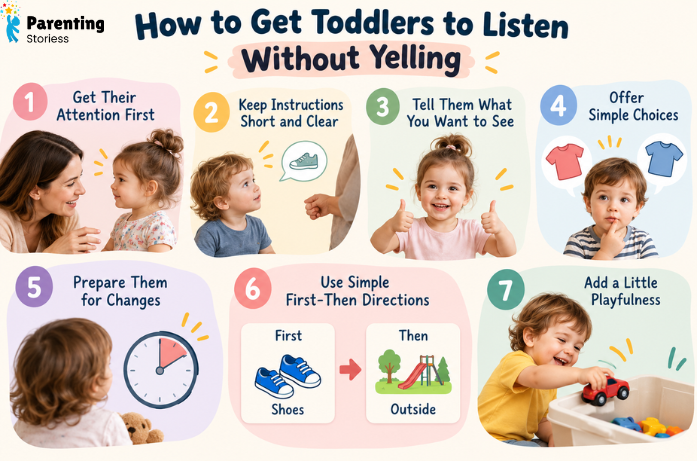
How to Get Toddlers to Listen Without Yelling
The goal is not to expect perfect obedience every time. Toddlers are still learning how to manage attention, emotions, and independence, so small changes in the way you communicate with them can often make everyday routines calmer and easier.
1. Get Their Attention First
Before giving an instruction, move closer to your child and gently get their attention. Say their name, pause for a moment, and then explain what you need them to do.
This works better than calling across the room, especially when your toddler is busy playing. You do not need to force eye contact, but helping them shift their focus toward you can make it easier for them to understand and respond.
2. Keep Instructions Short and Clear
Toddlers can easily lose track of long explanations, especially when they are tired or distracted. Try to keep your request simple and direct.
Instead of explaining why you are late and listing several things they need to do, give one clear instruction at a time. A short phrase like shoes on, please is often easier for a toddler to process than a long speech.
3. Tell Them What You Want to See
Toddlers often hear words such as no, stop, and don’t throughout the day. While those words are sometimes necessary, it can be more helpful to clearly tell your child what they should do instead.
For example, say walking feet instead of don’t run, keep your cup on the table instead of don’t throw it, or hands stay gentle instead of stop hitting. Clear directions give your child something specific to follow.
4. Offer Simple Choices
Small choices can help toddlers feel more independent without giving up important boundaries. This can reduce power struggles and make cooperation feel easier.
You might let your child choose between two shirts, decide whether to walk or hop to the bathroom, or choose which toys to clean up first. Just make sure both options are acceptable to you.
5. Prepare Them for Changes
Transitions are often difficult for toddlers because they may not want to stop an activity they are enjoying. Sudden changes can lead to resistance, even when the next step is part of a normal routine.
Give a short warning before it is time to leave the park, turn off a show, finish bath time, or get ready for bed. A simple reminder a few minutes beforehand can help your child adjust to what is coming next.
6. Use Simple First-Then Directions
First-then language can help toddlers understand the order of events. It makes your instruction feel more predictable and easier to follow.
You can say first shoes, then outside or first bath, then story time. The idea is not to bribe your child, but to clearly explain what happens now and what comes next.
7. Add a Little Playfulness
Some everyday tasks become easier when they feel like play instead of another demand. A little silliness can sometimes prevent a small struggle from turning into a bigger one.
You might pretend a sock is searching for a foot, race toy cars back into the basket, or see how quickly blocks can find their way home. Playfulness will not suit every situation, especially safety issues, but it can make many daily routines feel lighter.
What to Do When Your Toddler Ignores You
When your toddler does not respond, repeating the same instruction again and again can quickly become frustrating. Instead, give one short and clear direction, then allow a few seconds for your child to process what you said.
If they still do not respond, move closer and gently repeat the request. You can also offer help or a simple choice. For example, if it is time to put on shoes, ask whether they want to do it themselves or need your help. This keeps the situation calm while still showing that the request needs to be followed.
The CDC also offers guidance for parents on responding to toddler behavior in calm, consistent ways.
Notice When Your Toddler Does Listen
It is easy to focus on the moments when your child ignores you, but noticing cooperation is just as important. When your toddler puts away a toy, comes when called, gets dressed, or follows a safety instruction, acknowledge the effort.
Be specific rather than simply saying good job. Saying you put your toys away when I asked helps your toddler understand exactly what they did well and encourages that behavior in the future.
Healthy Children also recommends noticing positive behavior and using specific praise so children can better understand what they did well.
Ask Yourself: Can’t Listen or Won’t Listen?
Before assuming your toddler is deliberately refusing, think about what might be happening in that moment. A child who is hungry, tired, overstimulated, upset, or deeply involved in play may find it much harder to stop and follow a direction.
This does not mean you need to remove the boundary. Instead, adjust your approach. Use fewer words, offer a little help, and keep the expectation clear. Understanding the reason behind the behavior can help you respond more calmly without giving in.
Listen to Your Toddler Too
Toddlers are often more cooperative when they feel that their feelings are being heard. You do not have to agree with what your child wants, but you can acknowledge their disappointment.
If your toddler does not want to leave Grandma’s house, for example, you can recognize that they had fun and wish they could stay longer while still explaining that it is time to leave. Your boundary remains the same, but your child also feels understood and supported.
Common Mistakes That Can Make Listening Harder
None of us handles every situation perfectly, but a few common habits can make toddler listening more difficult.
- Giving too many instructions at once: Keep directions short and simple.
- Repeating yourself over and over: Give a clear instruction and then follow through.
- Giving directions from across the room: Move closer when possible.
- Asking when it is not really a choice: State the expectation clearly.
- Using threats for everything: Try to use calm, related consequences instead.
These small changes can make communication much clearer.
What About Tantrums After You Set a Boundary?
Your toddler can understand what you said and still feel upset about it. Being told no to another cookie, leaving the playground, or stopping a favorite activity can trigger big emotions, even when the boundary is clear.
In these moments, try to stay calm and keep the limit simple. You can acknowledge that your child is disappointed without changing your decision. A few calm words and a steady response are often more helpful than a long explanation.
Build Listening Skills During Calm Moments
Listening skills can also be practiced when nobody is upset.
Simple games are a great way to do this. Ask your toddler to touch their nose, bring you a block, hop two times, or put a spoon on the table.
Simon Says, action songs, and reading together can also help children practice following directions.
When listening feels playful, children get practice without feeling constantly corrected.
Spend Time Following Their Lead
Here is one thing that is easy to forget when we are focused on how to get toddlers to listen.
Sometimes children also need time when we stop giving directions.
Sit on the floor for a few minutes and let your toddler lead the play. Avoid correcting or teaching. Just notice what they are doing and enjoy being with them.
That simple connection can make children feel seen and secure, and cooperation often becomes easier when the relationship feels calm and connected.
When Not Listening May Need Extra Attention
Most toddler ignoring and limit testing is part of normal development. Still, sometimes not listening may be connected to hearing, language, or developmental concerns.
Consider talking with your child’s healthcare provider if your child:
- rarely responds to their name or everyday sounds
- does not seem to understand simple directions
- has noticeable speech or language delays
- loses communication or social skills they previously used
- often seems unaware when people speak to them
- makes you feel that something is not quite right
One difficult behavior does not tell you everything. Look at the bigger picture, including communication, hearing, play, and social interaction.
A Simple Listening Routine to Try
If you feel overwhelmed by parenting advice, keep it simple.
Before giving a direction:
- move close to your child
- say their name
- give one short instruction
- wait a few seconds
- offer a choice if appropriate
- calmly help them follow through
You do not need to try ten different techniques at once. Consistent, simple communication usually works better than changing strategies every day.
Final Thoughts From One Mom to Another
If your toddler doesn’t listen, it can make everyday routines feel exhausting. But toddlers are still learning how to manage attention, emotions, independence, and following directions, so progress often comes slowly.
Try to stay calm, keep instructions simple, and notice the small moments when your child does cooperate. Those little wins matter more than they may seem.
And on the difficult days, remember that one tantrum or rough bedtime does not define your parenting. You are helping your child build important skills step by step.
For more simple, supportive parenting tips, explore more helpful guides on Parenting Stories and make everyday parenting feel a little easier.